
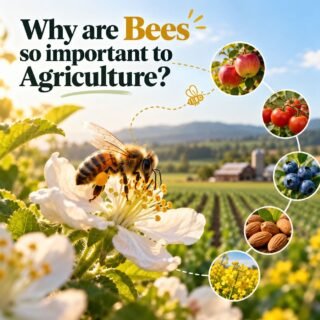
Why are bees so important to #agriculture?
On a busy farm, attention often goes to the visible work: preparing the soil, sowing seeds, watering crops and harvesting the produce. Yet another worker moves almost unnoticed among the flowers. The bee does not sow seeds or harvest crops, but through pollination, it helps many plants produce the fruits and seeds on which agriculture depends.
According to the Food and Agriculture Organization of the United Nations (FAO), pollinators such as bees, birds and bats affect around 35% of global crop production (by volume), enhancing the yield of 87 of 115 of the major food crops and numerous medicinal plants. Their contribution supports the cultivation of many fruits, vegetables, nuts and other crops, influencing both the quantity and quality of agricultural produce.
Some scientists estimate that one out of every three bites of food we eat exists because of animal pollinators like bees, butterflies and moths, birds and bats, and beetles and other insects.
Beyond crop yields, bees support biodiversity and agricultural livelihoods. However, habitat loss, pesticide exposure and other environmental pressures threaten pollinator populations.
Protecting bees through pollinator-friendly habitats and responsible farming practices helps safeguard the natural processes on which agriculture depends.
Sometimes, the smallest workers make one of the biggest contributions to our food systems.
Cargill DS Group Godrej Agrovet Limited DeHaat AWL Agri Business Limited Mother Dairy Fruit & Vegetable Pvt. Ltd. Indian Institute of Technology, Kharagpur Indian Agricultural Research Institute National Dairy Research Institute, Karnal Wageningen University & Research University of California, Davis Westfalia Fruit Tongaat Hulett